Showing posts with label Heathrow Airport. Show all posts

Friday, 2 January 2026

80 years ago: The Opening of Heathrow airport
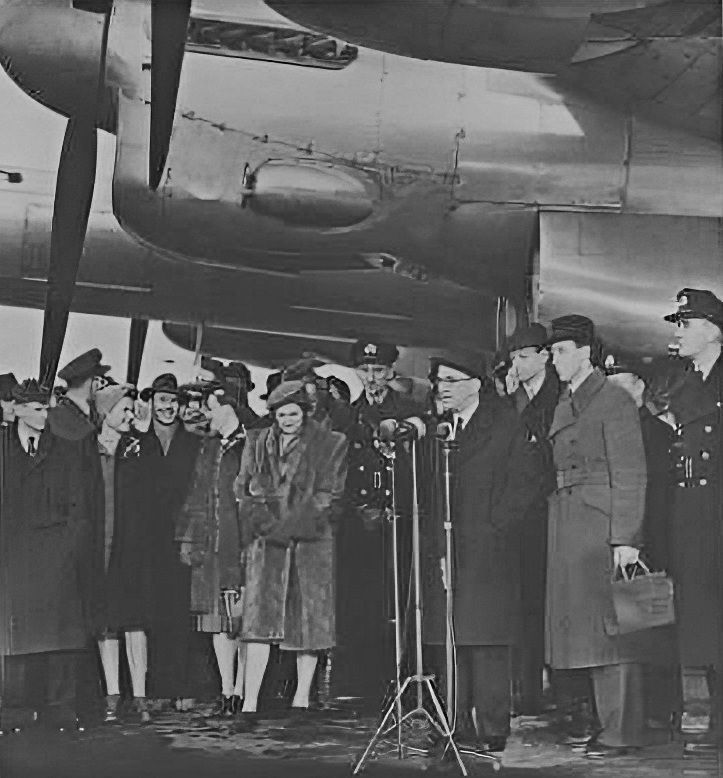
Lord Winster opening Heathrow Airport. (Halifax Evening Courier - Tuesday 01 January 1946)
Lord Winster opening Heathrow Airport.
(Halifax Evening Courier - Tuesday 1 January 1946)

       On a bright, dry, frosty morning, on a windswept expanse of concrete, a man in homburg hat, made a speech in front of a Lancastrian Starlight airliner. He was Lord Winster, the Minister for Civil Aviation, and he was there, on 1 January 1946, to mark the inaugural flight from the £20million new airport that was being built in West London. Lord Winster told the dignitaries that Heath Row would be the future civil airport of London and it already had the finest runway in the world, “This flight is the first step towards the establishment of swift and regular British air services to South America. Air Vice-Marshal Donald Bennett and all those flying with him today are truly ambassadors representing the spirit and determination of Britain to play the same leading part in the air as it always has at sea.”[1] The aeroplane, piloted by the Air Vice-Marshal had a crew of six, including Mary Sylvia Guthrie, 24-year-old ex-pilot of the British Air Transport Auxiliary, as the first air hostess.[2] It was flying via Lisbon, Bathurst, Natal (Brazil), Rio de Janerio and Monte Video. The aircraft took off on the 3000 yard runway, but only needed 1000 yards before it was airborne. It was also the day that the airport, built on land requisition by the Air Ministry for wartime use, was officially handed over to the Ministry of Civil Aviation. It had never been used by the R.A.F. although the runways had been built in the triangular pattern favoured by the R.A.F. It was soon pointed out by Airline officials that 100-ton airliners would not be able to use the airport with this runway configuration if the wind was north or south. The current arrangement would only be suitable for small aircraft which can land in a cross-wind.[3]


[1] Halifax Evening Courier - Tuesday 01 January 1946

[2] Illustrated London News - Saturday 12 January 1946

[3] Daily Express - Wednesday 02 January 1946
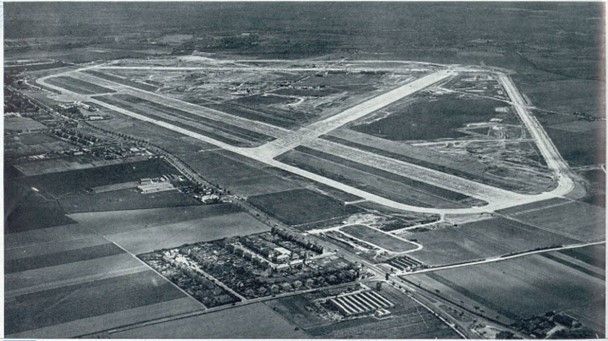
Airport runways under construction.
(The Sphere - Saturday 25 May 1946)

      On 25 March 1946, Lord Winster took a party of M.P.s, Peers, the Press, and Foreign attaches, to Heath Row to show them the facilities. At luncheon he announced that the airport would, from now on, be called the “London Airport”, as it was considered that the name “Heathrow” would be “a difficult word for many foreigners”.[1] This decision was reversed in 1966. He said that when the airport is in full service it would be able to deal with 160 aircraft an hour in good weather. The first three runways would be completed by summer and when finished the airport would be one of the largest and best equipped in the world. He went on to say that London Airport is the greatest engineering enterprise ever undertaken, and although the buildings do not afford the entry into the United Kingdom that we should like, they will improve as time goes on.[2] Work had already started on acquiring land for extending the airport to the north of the Bath Road which would involve the destruction of Sipson and Harlington villages, although, he said, work on building these three new runways would not begin until after 1950 and no demolition will take place before then.[3] This expansion plan was dropped because of cost, but the spectre of airport expansion has hung over the residents ever since.

      The airport was far from finished. After eighteen months of construction there was only one completed 3000 yard runway. At this time two million tons of earth had been excavated; 36,000 feet of ducting containing 60 miles of wire laid; 200 lorries, 40 excavators, 50 bulldozers used, as well as elaborate concreting equipment. More than 1000 men were housed and fed on the site.[4] However apart from the runways little else was ready.

      One of the first casualties of this “modern” airport was the “Fido” installation at Heath Row. This was an experimental system for dispersing fog on the airfield.[5] It had cost £400,000 in total and was expensive to run and not very successful, so the Minister cancelled the project.[6] Fog became a big problem in the winter at that time of chronic air pollution and the low lying Heathrow land that was a fog pocket. Not only that, but with the land almost at sea-level the water-table was close to the surface, and was frequently water-logged.

      The official opening of the airport to international aircraft took place on 31 May, when a BOAC Lancastrian arrived from Australia. It was two hours ahead of schedule, having completed the 12000 mile journey from Sydney in 63.25 hours.[7] Then a Pan-American Airways Constellation landed from New York. The flight took 14 hours with stops in Newfoundland and Shannon. The planes had landed in heavy rain and strong winds and the passengers had a dreary welcome. They had to walk on duck boards to reach the tented reception hall and customs house which were deep in mud from the recent rains.[8]


[1] Yorkshire Evening Post - Monday 25 March 1946

[2] Belfast News-Letter - Tuesday 06 April 1948

[3] Daily News (London) - Tuesday 26 March 1946

[4] Uxbridge & W. Drayton Gazette - Friday 04 January 1946

[5] Daily Express - Thursday 31 January 1946

[6] Dundee Evening Telegraph - Friday 20 December 1946

[7] Illustrated London News - Saturday 08 June 1946

[8] The Sphere - Saturday 29 June 1946
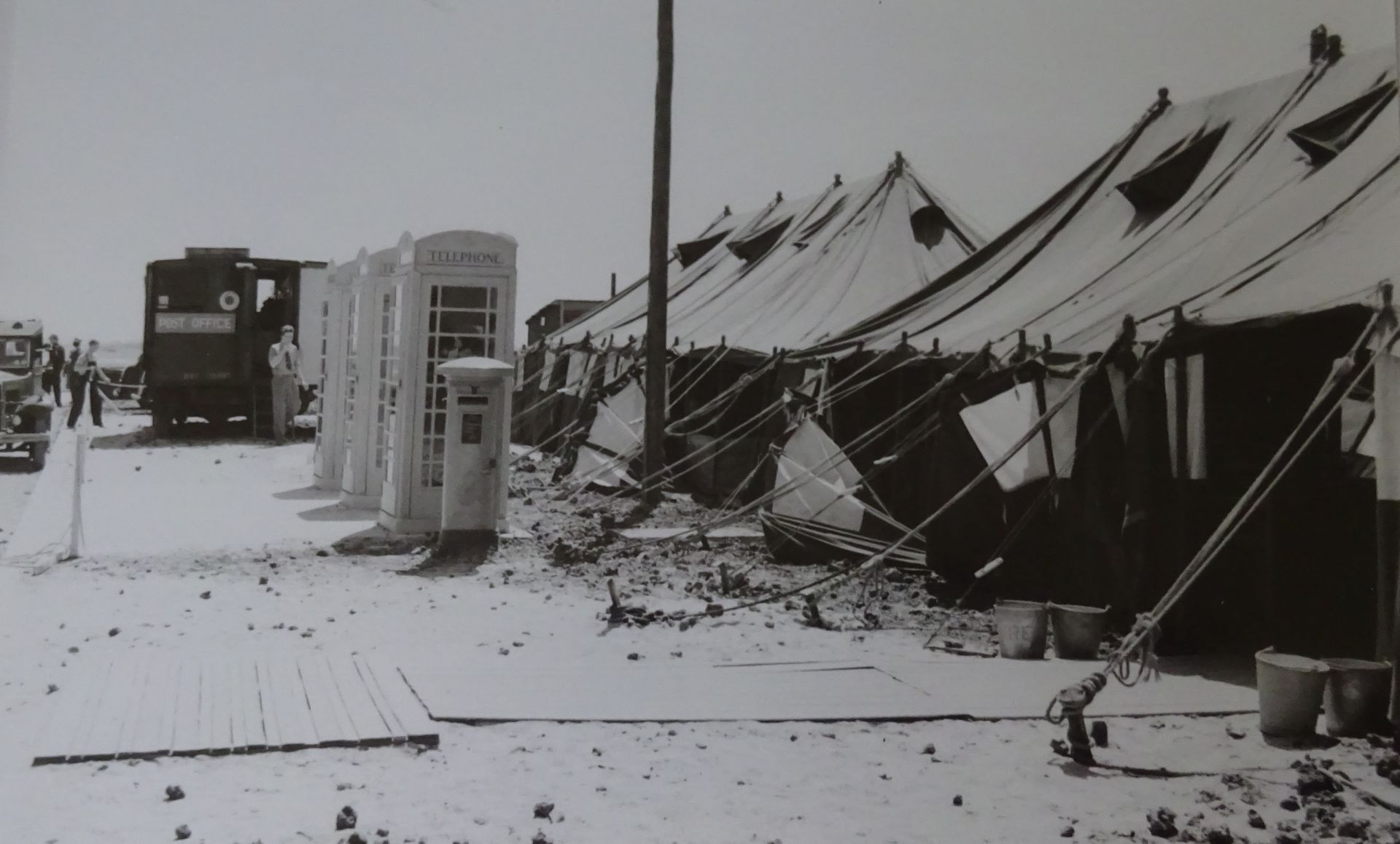
"Tent City".
(from the archive of local historian Douglas Rust)

      Only the Americans airlines were able to make the transatlantic flights because at that time Britain did not have planes capable of making the crossing with a payload of passengers. Lord Winster silenced the critics with assurances that the prospects were rosy and that although the Americans have their Constellations, Britain is developing its own long-range air transport.[1] He was referring to the development of jet aircraft.

      While Lord Winster was defending Britain’s aircraft development he also had to deal with ground-level protests about the airport expansion plans. Local councils, from around the airport, sent a deputation to see Lord Winster on 11 April 1946, but they received no satisfactory outcome.[2] They had submitted a number of amendments to the new Civil Aviation Bill in the interests of the inhabitants of their areas, to mitigate the disturbance any new construction would cause. The Bill allowed for diversion of highways, construction of drainage and utilities, and demolition of houses for which the occupiers would only get the value at 1939 prices plus 30 per cent – not enough to find similar accommodation at the current house prices. The local residents, even without the airport’s expansion plans, were finding their voice. They also started to protest about aircraft noise.[3]

      By September, with the increase in air traffic, there were worries about the inadequacy of radar at both Heathrow and Northolt airports, and the risk of accidents. The landing and take-off circuits at both airports, overlapped, and, as winter approached, concerns are being raised about the danger of poor visibility. The week before representatives from 37 countries, with 300 delegates, had met in London for a conference to discuss adopting international standards and common practice for radar technology. Britain’s radar pioneer, Sir Robert Watson Watt, estimated it will be two years before an international decision can be reached on standards for equipment, and a start made to install radar equipment on the ground at all international airports. At the conference the Government were keen to show the range of defensive radar equipment Britain had developed during the war, but delegates were astonished to learn that no civil airport in Britain had radar equipment. It was admitted that the Ministry of Supply and the R.A.F. could make this equipment available at the two London airports, but there had been no official explanation as to why this had not happened. It seems that although radar was developed as a means of defence, they were slow to recognise it had a new role in air safety.[4]

      More complaints about the conditions at the London Airport were aired by The Sphere journalist in October. The Board of Trade were keen to promote tourism, but as the Sphere magazine pointed out any high-grade visitors will be put off by the conditions at London Airport. The great American composer and songwriter, Irving Berlin had just flown to Britain. His plane was due to land at 11pm, but didn’t arrive until 5am. A group of film executives, producers and music publishers were there to greet him. They had to wait six hours without even being able to get a cup of tea. Simple refreshments like hot drinks and a bun could only be obtained during normal hours. The airport had no drinks licence, and even some of the technical systems were primitive. The runway lights had to be switched on by a man and a bicycle going out to the runway to switch them on. If the wind changed and another runway was to be used then he had to repeat the time-consuming trip to change the lighting. Hangers had started to be erected, but they were not large enough for the transatlantic aircraft, and there was no hard standing to park aircraft, they had to be put on unused runways, and if there was a change in wind direction and that runway was needed suddenly, then there was a frantic scramble to tow the aircraft elsewhere. At this time nine major airlines and a few minor ones were using the airport. They did so knowing the airport facilities were primitive. By this time a few of the tents were being replaced by prefabricated single-storey buildings. Brick-built buildings were not expected to be erected for another two years. Critics believed the airport had opened before it was ready, especially as there was only provision for temporary maintenance of the aircraft. The aircraft had to be flown elsewhere for major repairs.[5]

      The arrival of a B.O.A.C. Lancastrian plane from Sydney on 23 October 1946 marked the two-hundreth each-way trip on the longest and fasted air route in the world.[6] This achievement was over-shadowed by the fact that development at the airport had been halted by a week-long strike by the construction staff.[7] It was not a good start for the new Minister for Civil Aviation, Lord Nathan, but his troubles continued into the winter when fog was responsible for the cancellation of many flights.

      January 1 1946 was a day of many firsts:  the transfer of Heath Row airport from the Air Ministry to the Civil Aviation Ministry; the inaugural flight from the new civil airport for London; the resumption of civil flights in the UK post-war; and the day that B.O.A.C European Division took over commercial flights from 110 Wing of Transport Command.[8] It was a day of optimism. Air travel was seen as the future for Britain. It would make use of British engineering skills, boost jobs, and encourage tourism. The future looked bright.

 
[1] Daily News (London) - Thursday 10 January 1946

[2] Uxbridge & W. Drayton Gazette - Friday 21 June 1946

[3] Evening News (London) - Saturday 22 June 1946

[4] Daily News (London) - Monday 30 September 1946

[5] The Sphere - Saturday 19 October 1946

[6] Dundee Evening Telegraph - Wednesday 23 October 1946

[7] Gloucestershire Echo - Friday 25 October 1946

[8] Watson, Captain Dacre, BRITISH OVERSEAS AIRWAYS CORPORATION 1940 – 1950 AND ITS LEGACY, Journal of Aeronautical History, Paper 2013/03. https://www.aerosociety.com/media/4844/british-overseas-airways-corporation-1940-1950-and-its-legacy.pdf

For more historical stories of the area read:

 “The Vanishing Village: A Legacy Lost to Heathrow’s Third Runway”

by Wendy Tibbitts

 ISBN 978-1-7390822-2-22


Tuesday, 18 February 2025

Heathrow Expansion: Eighty years of Bad Decisions

Heathrow destruction 1944

In 1939, at the beginning of WWII there were 351 people living in the hamlet of Heathrow. Some went off to serve in the Armed Forces, but the majority stayed to do their “bit” for the war effort by producing fruit and vegetables to sell at London’s Covent Garden market. For the patriotic farmers of Heathrow it came as a shock when on the 2 May 1944 a letter dropped through their letter boxes to say their land was being requisitioned and they had two months to pack up their homes, outbuildings, livestock, and, leaving their growing crops in the fields, find somewhere else to live.[1] The letter was from the Air Ministry and was in response to a decision made at the wartime coalition’s Cabinet meeting on 10 April 1944 when the Ministers had approved the “sterilisation” of the whole of Harmondsworth for the development of an airport.[2] However, just before D-day, with manpower and money in short supply, the Government could not afford to build more than three runways. The airport was to be built in stages. Stage one would be to requisition land south of the Bath Road (A4) which would completely remove Heathrow.

BAD DECISION NUMBER 1
The decision to fix Britain’s first international civil airport at Heathrow had first been muted by Lord Abercrombie who was commissioned to produce a Greater London Plan for post-war London. With the growth of air transport he knew that a civil airport would be needed after the war and he suggested ten possible sites around London. All of these existing airports were surrounded by housing estates and not expandable. The only leading contender was the Fairey Airfield at Heathrow, but there were many objections. Sir Richard Fairey did not want to give up his airfield. The Ministry of Agriculture did not want to bury the land, which, in Abercrombie’s plan, was described as “… a soil fit to be ranked with the world’s very best – a high-class market gardening and orchard soil, also growing fine grass and ordinary farm crops.”[3] It was not until just before D-day in 1944 that the Air Ministry began to construct the first stage by building three runways which would be completed by May 1946 at a cost of £3.8m. This stage would concrete over the grass Fairey airfield and all the Heathrow farms.
Stage 1 Airport Layout

Two years later on 10 January 1946, even before the airport was complete, Atlee’s post-war Cabinet meeting discussed a memorandum put forward by the Secretary of State for Dominion Affairs, Viscount Addison.[4] It proposed the establishment of Britain’s main international airport at Heathrow. He said the site of the airport was chosen after prolonged survey of the London area and it was considered to be the only suitable location. It will be necessary to acquire a large tract of land to the north of the Bath Road as well as a number of areas adjacent to the present site. The total cost of acquisition of 4,219 acres will be £7m. About 170 houses would have to be demolished in the area south of the Bath Road as well as a substantial proportion of the 1026 houses in the area north of this road. Also there would need to be “sterilisation” of further land on which building would be “controlled”. The airport was to be called “London Airport” and the name Heathrow discarded. Estimated total cost of the airport, including rail and road construction, was £30 million, but he was unable to estimate how much revenue the airport would generate. Bizarrely the Minister was also considering leasing some of the “sterilised” area of land, and even the land between the runways, to market gardeners. Obviously not considering what aircraft engine emissions would do to the crops or the environment. Estimated use of the airport when two runways were available would be 500 flights a day in normal weather. Total passengers per day would be 8500 of whom 1020 would travel in peak hour. The number of passenger movements per day for the extended airport was “guessed” at 12,000 to 15,000.

BAD DECISION NUMBER 2
During the Cabinet meeting the Chancellor of the Exchequer, Hugh Dalton, accepted the need for an international airport at Heathrow but was concerned about the expenditure involved, and was not convinced that it was necessary at this stage to acquire land north of the Bath Road.[5] He strongly urged that the new enlarged scheme be postponed until 1950. Even though 2650 acres had already been destroyed and concreted, he proposed there should be a discussion about finding a new site for the airport where houses and valuable agricultural land would not be lost. The Minster of Town and Country Planning, Mr. F. Marshall, countered this by saying that all previous experience had shown the advisability of acquiring ample land in order to allow for unforeseen developments, and that unless the land was acquired now it was impossible to plan the development of the main roads in the neighbourhood. The Cabinet gave their approval for the development of the civil London Airport at Heathrow, which would be spread over the next eight years. [6]
Full airport plan proposed 1946

The civil airport opened in 1946. The original Fairey Hanger was used as a fire station, and ex-army tents were erected alongside the A4 as terminal buildings. The next phase of the development, which was to extend the existing runways, started in 1948 when more land to the south of the Bath Road was requisitioned. The Three Magpies public house on the Bath Road(A4) lost the remains of its six acres of land. The farms of the hamlet of Longford were requisition leaving so little agricultural land that farming was not viable. Only Perry Oaks sewage works remained. A further round of land requisition to the north of the Bath Road in 1960 for the building of a spur road from the M4 to the central airport buildings involved the demolition of the Old Magpies on the A4 and the removal of the farmland in Sipson. However as planes got bigger and passenger numbers increased there was still a need for a larger airport.

BAD DECISION NUMBER 3
The Roskill Commission was set up by the Government in 1968 to look into finding a site for a third London airport. London already had Heathrow and Gatwick and now there was a requirement for a four-runway airport. The Commission published its report in January 1971 and after initially considering 78 sites they recommended Cublington in Buckinghamshire as a suitable site. The Government rejected this suggestion and chose another site from the Commission’s short list which was Maplin Sands, Foulness Island, on the Thames Estuary. An Act of Parliament in 1973 paved the way for this development, but this was shelved after Labour came to power in July 1974. Instead a small-scale redevelopment of Stansted airport in Essex was agreed even though this was not a site short-listed by the Roskill Commission.[7]

BAD DECISION NUMBER 4
In 1991 the Transport Secretary, Malcolm Rifkind, promised a wide public consultation on the building of a third runway at Heathrow.[8] It started a wave of protest from local councils in Middlesex and Buckinghamshire, and local residents. [9] At the same time there were also suggestions that a fifth terminal could be built on the land then occupied by the Perry Oaks sewage works. The Middlesex Council were not happy about the loss of the sewage facility, and concerns were expressed by the Buckinghamshire County Council (on whose border it stood) about the increased noise and pollution of planes flying over the county.[10] All protesters were relieved when in October 1993 Heathrow Airport Ltd community relations manager, Jon Philipps, said Heathrow had no plans for a third runway as building a fifth terminal did not require another runway.[11]

BAD DECISION NUMBER 5
However in March 1994 the Department of Transport was holding exhibitions and public meetings about the possibility of building a third runway for completion by 2010. They leafletted all the homes in Harmondsworth and held exhibitions and public meetings in Harlington, West Drayton, Sipson, Uxbridge, Stanwell and Harmondsworth.[12] The preliminary design for the expansion would have removed the hamlet of Sipson, on the north side of the A4, and most of Harmondsworth. However in April 1994 at a meeting of the Hillingdon Council, whilst the public enquiry was still in progress, a copy of a letter from Heathrow Airport Limited was circulated. It read, “I can state categorically that at no stage has either Heathrow Airport Limited, or its parent company BAA plc given evidence to the RUCATSE (Runway Capacity To serve the South East) inquiry indicating support for another runway at Heathrow. The airport needs extra terminal capacity rather than runway capacity.” This letter was signed by Jenny Bradley, director of public affairs at Heathrow Airport Limited.[13] It was not until November 2003 that the government announced that there would be no third runway in the “short term” because to do so would break European pollution laws.[14] However, despite all the public enquiries and the protests from local councils and other public bodies, the fifth terminal was built and opened in 2008 which resulted in a subsequent increase in the number of flights from Heathrow airport.

BAD DECISION NUMBER 6
In 2012 the UK Government established an independent Airports Commission to look again at the future of London’s airports. The 2015 final report of this Commission concluded that Heathrow Airport required a new northwest runway.[15] On 25 June 2018 the House of Commons voted to adopt this recommendation. This time the plan was to demolish the hamlet of Longford on the western edge of the airport, and to extend the runway over the M25 with the motorway disappearing into a tunnel. The Colne River would also be placed in an underground culvert. The hamlet of Sipson would survive but would be so close to the third runway that life in any of the houses would be unbearable. The timetable for the construction was to begin in 2021, when planning consent would be sought from the various local councils, and then construction would begin in 2023. Fate intervened with the schedule in the shape of the pandemic of 2020, when air travel was severely reduced and extra airport facilities were not needed. All talk of building a third runway was quietly dropped, but the residents of the parish of Harmondsworth and its hamlets of Sipson and Longford were left, once more, in limbo with the threat of demolition postponed but not removed. After a change of Government, in January 2025 the new Administration revised the prospect of a third runway and once more the protests began. Successive governments with their short-term thinking and procrastination have blighted Harmondsworth parish for eighty years. The constant threat of further airport expansion, the insecurity of tenure, and uncertainty for the future, has caused a slow decline in the number of long-standing families staying in the parish. Speculators have moved in to buy up property, letting them out on short-term leases, or turning them into houses of multiple occupancy. Some of the many ancient Grade II listed buildings have been left unoccupied and decaying. If the voice of the 1946 Minister of Town and Country Planning had been heard, and sufficient land purchased at the outset for future development of the airport, it might have avoided the prolonged indecision and decades of controversy. Meanwhile the residents of Longford, Sipson and Harmondsworth are in limbo. They have fought hard over decades to preserve their pretty villages that have survived since the Saxons built settlements there. These once peaceful rural agricultural villages with over twenty listed buildings are once again facing an uncertain future.

For the story of what will be lost under the Third Runway read:
‘Longford: A village in Limbo’ by Wendy Tibbitts.

[1] Sherwood, Philip. Heathrow: 2000 years of history, (Stroud, 1999)
[2] The National Archives CAB 66/48/39
[3] Stamp, L.Dudley, ‘Land Classification and Agriculture’, in Abercrombie (ed.), Greater London Plan 1944. (London, 1945),p.87
[4] The National Archives. CAB 129/6/4 5 January 1946
[5] National Archives CAB 128/5/4
[6] The National Archives' reference CAB 66/48/39 April 1944
[7] Wikipedia. https://en.wikipedia.org/wiki/Roskill_Commission#
[8] Middlesex Chronicle - Thursday 10 January 1991
[9] Harefield Gazette - Wednesday 25 March 1992
[10] Bucks Advertiser & Aylesbury News - Friday 15 June 2001
[11] Hayes & Harlington Gazette - Wednesday 20 October 1993
[12] Uxbridge & W. Drayton Gazette - Wednesday 16 March 1994
[13] Uxbridge & W. Drayton Gazette - Wednesday 27 April 1994
[14] Wolverhampton Express and Star - Saturday 29 November 2003
[15] Wikipedia. https://en.wikipedia.org/wiki/Airports_Commission

Wednesday, 15 June 2022

Tales from Longford: The Shy King and the Soldiers Shed


Image taken from: Bath Road by Charles G. Harper. http://www.gutenberg.org/files/37921/37921-h/37921-h.htm


King George III of Great Britain was a shy man. He did not like travelling nor meeting people. As he got older he made Windsor Castle his principle dwelling, and spent a lot of money on renovating and furnishing the castle to his taste. Occasionally he had to travel to London for matters of state.

The journey between London and Windsor took him along the Bath Road through the villages of Hounslow and across the notoriously dangerous Hounslow Heath to Longford in Middlesex. Previous Monarchs would make a stop at the Kings Head in Longford (later called the Peggy Bedford) to change the carriage horses.  However George III did not like meeting the public so he had his own stables built along the route. One was at Hounslow and another one was a mile from Longford near the 14th milestone (measured from Hyde Park Corner). These buildings were isolated, square brick buildings with bright red pantiled roofs, with doors at the front and windows that faced up and down the road.[1]

     On a cold damp winter’s day in January 1805, George III was returning to Windsor from making what turned out to be his last speech at the Opening of Parliament. He sat snugly in his carriage wrapped in fur rugs and, as the carriage and his military escort stopped at a modest building known locally as the “Soldier’s Shed” on the Great Bath Road not far from Longford. [2] There, already waiting for his arrival were another troop of escorting soldiers ready to take over escorting the King to Windsor. Only this day it was different. Unfortunately, due to bad communication, two military parties turned up to take over as escort to the King. After the change of horses, as the carriage continued its journey towards Longford, the Light Dragoons took their place as the escort. The Oxford Blues insisted it was their duty and a scuffle ensued. Both parties defended themselves with swords drawn whilst his Majesty’s carriage was still going on at the usual pace and each party doing its duty and trying to keep position as escort. After some distance, the Light Dragoons gave up and the Blues continued as escort.[3] Out in the fields alongside the Bath Road watching the entertaining spectacle of two mounted troops fighting each other, were the field workers who politely doffed there caps as the King’s carriage passed, puffed on their clay tobacco pipes and then returned to their toil.

This was one of the last journeys King George III made. With the reclusive King now living at Windsor Castle, the “soldiers shed”, and the one and a quarter acres around it, were no longer used, but stayed in the possession of the Crown Estates until 1859, when Queen Victoria’s Commissioners of Her Majesty’s Woods Forests and Land Revenues sold it to local landowner, William Philp  for £60.[4]  The building was still there in 1910 although in a decrepit state.

The place were the “soldier’s shed” once stood is now the offices of HM Customs and Excise. This building is sandwiched between the Bath Road (A4) and the northern perimeter road of Heathrow airport. Its carpark the replacement for the green field on which the Royal Horses once grazed.


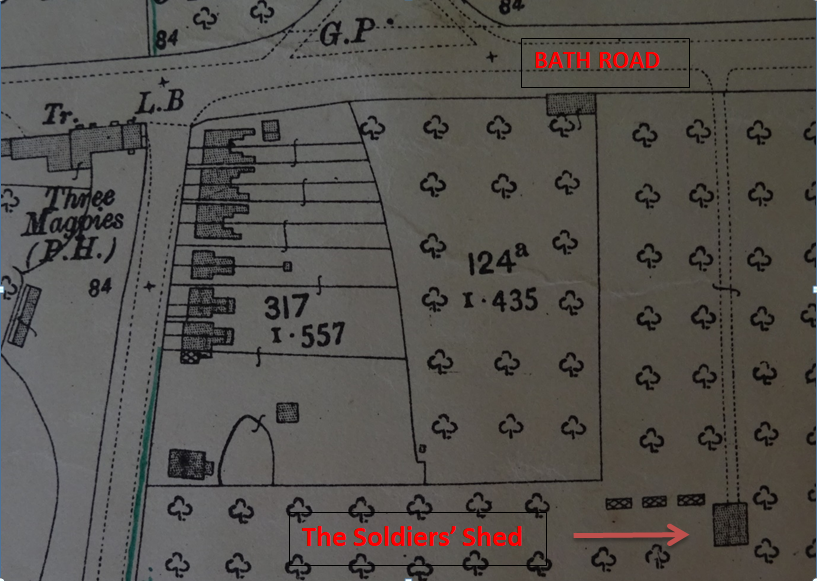
The site of the Soldiers Shed in 1895

The site of the Soldier's Shed today

My book: Longford: A Village in Limbo is due for release shortly

[1] Harper, Charles G., Half-hours with the Highwaymen, (London, 1908)

[2]Belsham, William, Memoirs of the Reign of George III.: From the Treaty of Amiens, A. D. 1802, to the Termination of the Regency, A. D. 1820 : in Two Volumes, Volume 1, (Hurst, Robinson, 1824 - Great Britain) p.80

[3] Evening Mail - Monday 21 January 1805

[4] London Metropolitan Archives. Acc2305/PH/17/1[?]