Saturday, 28 January 2023

Tales from Longford: The King's Secret Island


The Island House, Longford, by Archibald Robertson 1792.


There is a four-acre inhabited island at Longford, Middlesex, little known to outsiders.  The residents of the island would like to keep it that way. It is a peaceful haven surrounded by the River Colne in an unexpectedly tranquil setting considering its location in between the M4, the M25 and London’s Heathrow airport.

Ancient folk knew the advantage of making settlements near water. The water was needed for drinking, washing, crop irrigation and cattle rearing. The banks of the River Colne in Middlesex attracted the Saxon invaders who began to settle in clearings they made in the Middlesex Forest and gave the settlements appropriate names.[1]  Longford is part of the parish of Harmondsworth which belonged to Harold Godwinson the last crowned Saxon King who died at the Battle of Hastings in 1066. William the Conqueror then gave the parish to Abbey of Holy Trinity, Rouen, before it passed to the Bishop of Winchester, and was acquired by King Henry VIII in 1543.[2] The King assigned the parish to a nobleman, but kept ownership of the island at Longford and it remained Crown property until 1874.

There was a mill on the island at Longford mentioned in the Domesday book of 1086. At various times it was repaired or replaced and the waterpower was used for a variety of commodities.  Sometime before 1745 a substantial house, known as Island House, was built on the tip of the island nearest the bridge that led to the Bath Road. The site is now an apartment block. As well as the mill and its outbuildings there were two acres of meadow land, and footbridges led to smaller islands. The strip of land running along the opposite bank of the river, with its fishing rights, was also the King’s property.


Island House was one of the largest buildings in Longford.  It was leased to various London gentry who used it as their country abode, and the meadow and mill were often leased separately.  In 1747 when there were 16 taxpayers in Longford, Mr Hurst was paying nineteen shillings and sixpence in land tax for the island.  By 1767, when George III was on the throne, there were 25 tax-paying households in Longford, and a Mr Burnet was paying taxes on Island House.  George III’s long reign was marked by continual global conflicts and more taxes were needed in order to raise money to fight these wars. In 1770 a window tax was imposed on the residents. From the returns for Longford we can see that the two largest buildings in Longford were the Tudor-built ‘Yeomans’,  and Island House.[3]  Both had 19 windows and were paying £1.11s.6d in tax.  By 1772 Thomas Willing was the occupant at Island House and paying the same amount of tax as his predecessor.

Thomas Willing was a Quaker businessman from London, originally from Bristol, whose brother was Mayor of Philadelphia, and whose nephew was later involved in the formation of the American Independence movement.[4]  Thomas Willing died at Island House in 1773 and was buried in the chancel of St. Mary’s, Harmondsworth.  In his will he left the lease of Island House  to his niece, Dorothy Stirling whose husband was Admiral Sir Walter Stirling. Dorothy brought up her three children at Island House while her husband was away at sea, but by 1782 with her children all grown up she journeyed to Scotland to visit her married daughter. There she became ill and died aged 42. Her husband lived another four years and on his death his body was brought back to Harmondsworth to be buried in the church.

Dorothy had left the lease of Island House to her eldest son, Sir Walter Stirling, who was a banker in the City of London. His bank was doing well and he married an heiress from Kent. He also became an MP, a fellow of the Royal Society, and a High Sheriff of Kent. He and his wife, Susanna had a son and four daughters, but shortly after giving birth to her last daughter, Mother and daughter died. Both were buried in one coffin in St Mary’s church, Harmondsworth.  More bad news was on the way for Sir Walter. There was  a banking crisis in 1825 which resulted in a run on the banks and small bank’s like Sir Walters were unable to pay their depositors. The bank collapsed owing thousands to their customers. Sir Walter had to sell all his assets including his property in Kent and Middlesex. It took him two years, but he did eventually manage to pay all his debts and restore his reputation. When he died in 1832 aged 74 he was brought back to Harmondsworth and laid to rest at St Mary’s.  In 1833, his brother, Charles, who was an Admiral like his father, died and was brought back to Harmondsworth to be buried next to his wife. This ended the 60-year association the Willing/ Stirling family had with Harmondsworth.


In April 1788 plans were put forward for a new mill to be built on the Island on the tributary nearest the village.[5] This replaced the paper mill which had ceased running eighty years earlier. It is now the site of Colne Cottage. The new water Mill with its spacious yard and a range of workshops and buildings was leased to a series of calico printers by George III's Crown estates.

In 1791 it was Robert Buchanan who was insuring he premises, [6] and in 1799 the tenants were Edmund Hill and John Thackrah we were paying rent of £17.7s.6d per annum.[7] Thackrah and Hill renewed the lease in 1806 for 41 years. Island House and two acres of meadow were leased to a member of the Jarvis family. The Jarvis family were a long-term dynastic Baptist family that had lived in Longford for centuries. Thomas Jarvis was occupying the Island House when he died in 1823. He and his wife did not have children, but he amassed a fortune as a property auctioneer in the late 18th century and when he died his bequests changed the fortunes of most of his nieces and nephews. He left land to two of his nephews, Thomas and William, and his bequest virtually doubled their landholdings. The condition of the bequests were that their mother, who was already living in Island House, would remain there for her lifetime and the two brothers would support her. In his will he rather pointedly left them the land and stipulated that they should carry on the farming business as tenants in common, “without any difficulties” implying that the brothers had had “difficulties” in the past and he was hoping to restore peaceful relations between them.

The leaseholders of the mill, Hill and Thackrah,  sublet the house and business in 1833 when the sale of the lease was advertised as being sold “without reserve”. The house and its garden, together with a length of the opposite bank of the Colne, which had fishing rights, was sold to John Batchelor.  Andrew Inight bought the lease to the Mill and its own patented machinery for printing of calico and other fabrics on a flat bed press, plus other presses, boilers, stoves, winches, and other equipment.[8]  These two purchasers either did not know that the properties were leasehold, or hoped that if they kept quiet long enough the freehold would revert to them, but the Crown caught up with them.

On 13th May 1850 the pair’s solicitor was in court to defend an action brought by the Attorney General over who actually owned the island.  Their defence was that they did not recognise the  Crown as owners of the island and claimed that as they had not been paying “rent or profits” to the Crown for 20 years the island had reverted to their ownership.  However the Receiver General for the Crown produced receipts that showed the rent had been paid annually in the name of the original leasees until the expiration of the lease in October 1847 when the payments ceased.  After hearing all the evidence the Judge ruled in favour of the Crown and the defendants were evicted from the disputed land and premises.[9]

By 1874, with Queen Victoria on the throne, the Crown were selling the Freehold of the whole island and all the buildings on it. It included a separate island and a thin strip of land along the opposite river bank plus all the buildings.[10]

There is no mention of a mill in the sale details, but there are two meadows each of over an acre in land and a kitchen garden with fruit trees, where violets were being grown for sale. The main Island House is described as “Old-Fashioned” and there is a stable for two horses, a coach house, cottage, wash-house  and baking oven. The occupier was James William Jarvis, Market Gardener, a yearly tenant who was under notice to quite at Michaelmas 1874. At the auction the whole island was bought for £750 by George Shuter, of London, a potato salesman.  His Company, George Shuter Ltd, was a very successful Potato Sales business which was still trading at Covent Garden in 1971.

George Shuter also happened to be married to James William Jarvis’s eldest daughter and he had bought it so that his father-in-law could continue his tenancy. However, the 1870s was a bad time for British agriculture when there was a collapse in grain prices. Jarvis was struggling. By 1880 he was in the bankruptcy court.[11] He continued to live in Longford, but to make ends meet he became a travelling salesman before eventually moving to Park Lane, Hayes, where he died in 1894.

In 1892 the freehold of the Island was once more up for sale by auction, but failed to sell. It was then sold by private treaty. The Island passed through several more owners and in 1897 was put up for auction by Mr J.T. Lane who advertised the remodelled family home as a ‘Summer residence’ or ‘Hunting Box’.[12] A London businessman, Thomas Fuller Toovey, bought it as a home for his retirement. Although only 40 he had made his money designing and manufacturing bicycles. He moved into his house on 30 June 1898. He had paid £1080 for it and spent another £800 in alterations.[13] He and his wife lived there most summers, but they would let it fully furnished for three months or more each October.  By November 1905 Toovey was selling the entire contents of the house and outbuildings, which included a 8hp Peugeot motor car and a 2¾ hp motor bicycle, as he was “going abroad”, although he retained the freehold.[14] From December 1905 Joseph Perrin, a button merchant had a seven-year lease on Island House. The Perrin family attended Poyle Congregational church where their son Edward was Secretary for the newly formed Poyle and Colnbrook Congregational Institute.

It appears that Joseph Perrin did not renew his lease because by February 1913 the house had been redecorated and was available for rent.  In October 1914 Mr Pagesmith was given a seven-year lease on Island House at £120 p.a.  There was a dispute however in August 1915 between owner and tenant over some tools and equipment on the property that Pagesmith had agreed to purchase from T.F. Toovey. The payment was not made and Toovey took Pagesmith to Uxbridge County Court before successfully getting his payment.

Mrs Pagesmith was a member of the Harmondsworth Women’s Institute. In August 1923 she hosted a summer garden party for all its member in the “old-world” garden of Island House. There was a jazz band, punting, games and refreshments. The party ended at 10pm with fireworks.[15] The family were still there in 1926 when Mrs Pagesmith was advertising for a house-keeper. By 1939 Frank Pagesmith was dead but his wife and son, Gordon, were still living in Island House.  Gordon had been a City of London rubber broker, but in 1930 had been declared bankrupt and was forbidden to deal after some of his speculations left a £56,000 deficit. By 1939 he was calling himself an “Estate Manager”. Another son, Norman was a Music Hall entertainer and the third son, Saxon, had the Fairfax plant nursery in Hounslow. Gordon and his mother breached the blackout regulations in 1941 and were fined 20 shillings. They continued to live at Island House until 1948 when Blanche Pagesmith died aged 84. Gordon moved to Staines and died there in 1957.[16]

By the time the  1939 register was drawn up there are several other residences on the Island. In Island Cottage lived Mr and Mrs Howard. Colne Cottage housed Mr and Mrs Begg. The Rees lived at Banco, and there were two other houses: Watersmeet, and Riverside.


The island has continued to be a delightful, hidden, part of residential Longford. Now the island is under threat from the proposed Heathrow Airport Expansion.  If the third runway is built the island will disappear, the buildings will be demolished and the tranquil river Colne, which has given sustenance and industry to Longford for centuries, will disappear into an underground culvert. We must treasure the island and its history while we can.

 The river Colne 2018


For more on the history of Longford read “Longford: A Village in Limbo” by Wendy Tibbitts

For a “Look Inside” option go to  https://b2l.bz/WUf9dc   or scan the QR code:


[1] Bate, G.E. And So Make a City Here, (Hounslow, 1948)

[2] Impey, Edward, The Great Barn of 1425-27 at Harmondsworth, Middlesex. (Swindon, 2017)

[3] London Metropolitan Archives, LMA/4067/A/03/005

[4] Tibbitts, Wendy, Longford: A Village in Limbo, (Dorset, 2022)

[5] The National Archives, MPI 653, part 2, DSCF7826.jpg

[6] London Metropolitan Archives MS 11936/378/588220

[7] The National Archives E 367/6134

[8] Windsor and Eton Express - Saturday 26 January 1833

[9] London Daily News - Tuesday 14 May 1850]

[10] The National Archives, MPI 653, part 1

[11] https://www.thegazette.co.uk/London/issue/24902/page/5775/data.pdf

[12] Middlesex County Times - Saturday 08 May 1897

[13] 1910 Valuation Survey Field Book. TNA IR 58/39632

[14] West Middlesex Gazette - Saturday 25 November 1905

[15] Uxbridge & W. Drayton Gazette - Friday 10 August 1923

[16] Uxbridge & W. Drayton Gazette - Friday 14 March 1941


Wednesday, 15 June 2022

Tales from Longford: The Shy King and the Soldiers Shed


Image taken from: Bath Road by Charles G. Harper. http://www.gutenberg.org/files/37921/37921-h/37921-h.htm


King George III of Great Britain was a shy man. He did not like travelling nor meeting people. As he got older he made Windsor Castle his principle dwelling, and spent a lot of money on renovating and furnishing the castle to his taste. Occasionally he had to travel to London for matters of state.

The journey between London and Windsor took him along the Bath Road through the villages of Hounslow and across the notoriously dangerous Hounslow Heath to Longford in Middlesex. Previous Monarchs would make a stop at the Kings Head in Longford (later called the Peggy Bedford) to change the carriage horses.  However George III did not like meeting the public so he had his own stables built along the route. One was at Hounslow and another one was a mile from Longford near the 14th milestone (measured from Hyde Park Corner). These buildings were isolated, square brick buildings with bright red pantiled roofs, with doors at the front and windows that faced up and down the road.[1]

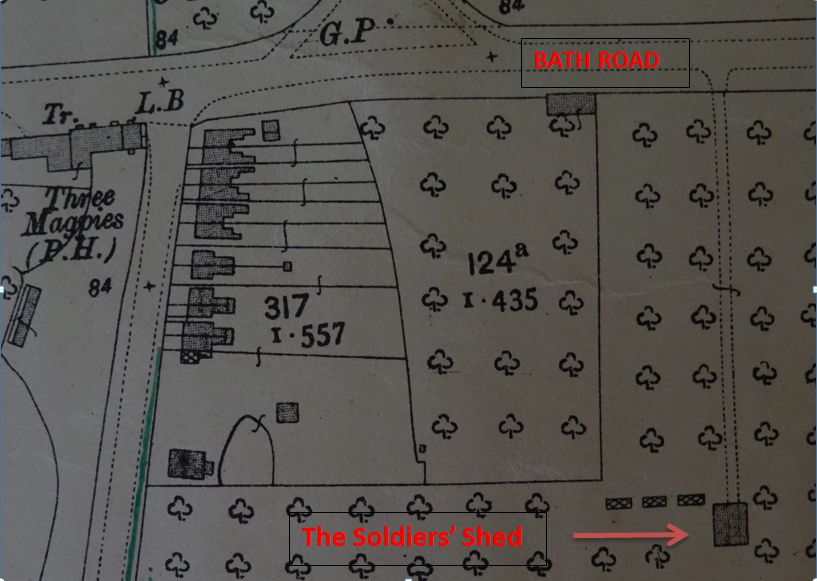
     On a cold damp winter’s day in January 1805, George III was returning to Windsor from making what turned out to be his last speech at the Opening of Parliament. He sat snugly in his carriage wrapped in fur rugs and, as the carriage and his military escort stopped at a modest building known locally as the “Soldier’s Shed” on the Great Bath Road not far from Longford. [2] There, already waiting for his arrival were another troop of escorting soldiers ready to take over escorting the King to Windsor. Only this day it was different. Unfortunately, due to bad communication, two military parties turned up to take over as escort to the King. After the change of horses, as the carriage continued its journey towards Longford, the Light Dragoons took their place as the escort. The Oxford Blues insisted it was their duty and a scuffle ensued. Both parties defended themselves with swords drawn whilst his Majesty’s carriage was still going on at the usual pace and each party doing its duty and trying to keep position as escort. After some distance, the Light Dragoons gave up and the Blues continued as escort.[3] Out in the fields alongside the Bath Road watching the entertaining spectacle of two mounted troops fighting each other, were the field workers who politely doffed there caps as the King’s carriage passed, puffed on their clay tobacco pipes and then returned to their toil.

This was one of the last journeys King George III made. With the reclusive King now living at Windsor Castle, the “soldiers shed”, and the one and a quarter acres around it, were no longer used, but stayed in the possession of the Crown Estates until 1859, when Queen Victoria’s Commissioners of Her Majesty’s Woods Forests and Land Revenues sold it to local landowner, William Philp  for £60.[4]  The building was still there in 1910 although in a decrepit state.

The place were the “soldier’s shed” once stood is now the offices of HM Customs and Excise. This building is sandwiched between the Bath Road (A4) and the northern perimeter road of Heathrow airport. Its carpark the replacement for the green field on which the Royal Horses once grazed.


The site of the Soldiers Shed in 1895

The site of the Soldier's Shed today

My book: Longford: A Village in Limbo is due for release shortly

[1] Harper, Charles G., Half-hours with the Highwaymen, (London, 1908)

[2]Belsham, William, Memoirs of the Reign of George III.: From the Treaty of Amiens, A. D. 1802, to the Termination of the Regency, A. D. 1820 : in Two Volumes, Volume 1, (Hurst, Robinson, 1824 - Great Britain) p.80

[3] Evening Mail - Monday 21 January 1805

[4] London Metropolitan Archives. Acc2305/PH/17/1[?]

Monday, 6 December 2021

Yeomans and the Tax Collector

Yeomans and the Tax Collector
Yeomans, Longford, Middlesex

Thomas Streeting was not a popular man. He lived in the biggest house in the village of Longford, Middlesex, and employed many of the villagers to work on his farm. This non-conformist land-owner might have received the respect of his labourers, but in some households he was unwelcome. He was the parish tax collector and twice a year he visited every house in the village to collect taxes. 

The tax collector’s job was unpaid. The gentry of the parish formed the Vestry Meeting (parish council) and oversaw the parish governance. Each member of the Meeting was expected to play an important, but voluntary, role. One member would be appointed as tax assessor. His job was to assess the rental value of each property, and this would be the figure on which the land and poor relief tax was based. The assessment varied little from year to year. Then the nominated tax collector, in this case Thomas Streeting, would have the job of extracting these sums from his friends and neighbours in the parish.

There were government taxes to be collected, too. In 1748 there were 34 land tax payers in Longford. This was a regular tax paid twice yearly from 1692 until 1963. However, in the reign of George III, this was not enough to fund the various conflicts that Britain was fighting in Europe and Colonial America, and so other sources of taxation had to be found, some of them very inventive. In 1696 window tax was introduced which was easy to assess. The Longford records for the years 1766/1767 show who had to pay window tax. Most houses, with seven windows or less paid a flat amount of two shillings a year. For larger houses there was a variable rate. In 1767 Thomas Streeting, as owner of one of the largest houses in Longford with nineteen windows, was paying twelve shillings for his window tax and £4.17.6d for his land. Thomas Streeting died in December 1773 and his son-in-law, Thomas Weekly, at the Weekly house took on his role as Tax Collector. Thomas Weekly’s voluntary job of collecting taxes was now not just a time-consuming, form-filling, distraction from his farm and his Baptist chapel, but was an onerous role to perform when individuals objected to having to pay extra tax when they were struggling to survive after the poor harvests of 1795.[1]

There were so many different taxes to collect that parish tax collectors received a preprinted form from the government to help them enumerate them all. Previous tax collections in the parish had just been noted in a hand made notebook. One new tax was on male servants (1777-1852). A male servant was considered a luxury and their employers' were liable to pay tax for this privilege. Those servants engaged in husbandry, trade or manufacture were exempted. The servants of tavern-keepers, shop-keepers and merchants were also exempt unless they performed any personal duties like scrubbing floors or cleaning shoes, or saddling a horse. In 1779 this tax was one guinea per servant per year.

Another tax was Horse Tax (1784-1874). This was liable on riding horses, including racehorses, but not working horses. In 1785 an amendment exempted those farmers occupying a farm worth not more than £150 a year rent in which the horse was used only for riding to church or market. The yearly rental exemption rate was reduced in 1802 and thus many more owners were liable.

There was also a dog tax (5 July 1796 to 5 April 1797). This was a tax on non-working dogs, and people receiving poor rate were exempt. Most people in Longford had just one dog, but Mrs Bedford at the Kings Arms inn (now the Grade II listed King Henry or The Stables) had two dogs.

The following tax year, there was also a clocks and watch tax with a variable rate depending on whether the watch was gold, silver, or of another metal. Thomas Weekly’s tax bill was 4s.10½d on his thirteen windows, and 11s.3d on his five horses. He had one clock and one silver watch for which he paid five shillings seven and a half old pence. Of the 60 householders/rate payers in the parish only 35 had a clock and 5 had two clocks. No one had a gold watch. This tax was repealed nine months later. It was difficult to collect because people hid or disposed of their clocks and watches. Inn-keepers were happy to pay the tax when they found that their clocks attracted customers who came in just to check the time, but it was devastating for the clock and watch manufacturers when people no longer bought them.[2] Not only was the tax payer liable to these sundry taxes, but in some years a surcharge of 20% was added to the total.

In 1796 Britain, after years of fighting in the American war of Independence and in the process losing the colonies, was now fighting a war against Spain and a separate conflict with France. The government needed to introduce more taxes to fund these wars. They had already been levying tax on all types of possessions, but then the Prime Minister, William Pitt the Younger, in anticipation of the need to establish a war chest of cash in case of a war with Napoleon who had just became First Console of France, had to think of other means to raise tax. In addition to the supplementary taxes in 1799 the Prime Minister introduced, the concept of income tax as a means of raising funds for the government. It was the first tax to be raised on people’s incomes and was intended as a temporary tax.[3] Anyone earning over £60 per annum had to pay ten per cent of their income. Initially it had to be collected from individuals and was not deducted at source until four years later. However, most of Longford’s labourers earned less than £1 a week and were not eligible. The introduction of this tax reduced Pitt’s popularity.

Those eligible to pay tax sometimes struggled to find the money, especially when the amount demanded varied from year to year. The increasing taxation was inflationary making goods cost more, but wages did not keep up. A pound in 1795 would be worth £117 today. This does not seem an excessive amount to pay today, but compared to the average earnings of an agricultural labourer of fifteen shillings a week, all of which would go on food and rent, for some people it would be a struggle.[4] This is why the parish tax collector was not a popular man.

[1] https://bahs.org.uk/AGHR/ARTICLES/01n1a5.pdf
[2] https://taxfitness.com.au/Blog/the-clock-tax-of-1797#:~:text=The%20tax%20was%20introduced%20by,their%20clocks%20or%20destroyed%20them. [3] www.politics.co.uk
[4] A Short History of English Agriculture by W. H. R. Curtler

This house and the village of Longford in West Middlesex will be demolished if the third runway at Heathrow airport is built.  My book, Longford: A Village in Limbo, which tells the story of Longford over the last three hundred years, is due for publication soon.

Thursday, 4 November 2021


Tales from Longford: The Weekly House

This house and the village of Longford in West Middlesex will be demolished when the third runway at Heathrow airport is built.


The Weekly House 2018.

It had been ten years since the Great Fire of London, and Thomas Weekly, a wealthy London cloth-merchant was looking for a change in lifestyle. His ride along the Great Bath Road from his home in Westminster led him to the village of Longford, fifteen miles from London, in search of a farm that was for sale in the centre of the village.  Recently married he wanted to build a home for his bride and establish himself as a farmer and maltster.  As a Baptist, and a descendant of John Wycliffe, the medieval theological reformer, he was attracted to this village of non-conformists, who were now openly able to meet without fear of prosecution.

Thomas Weekly bought the farm and built the Weekly House as a family home. It was quite different from the timber-framed Tudor inns and houses that already existed in the village. The house was two storeys high and built of red-brick with two attic rooms, and a high pitched tiled roof. The walls were thick and the large sash windows had internal wooden shutters.

The two main rooms had huge beamed fireplaces large enough to stand-up in, with recesses in the chimney for smoking hams. These fireplaces and those of the bedrooms all connected to the central chimney. The beautiful staircase with wooden bannisters continued up to the attic on the second floor where there were two large attics rooms and a box room. On the northern side of the ground floor was a single-storey cool store room with hooks for storing hams and next to that a white washed dairy. On the eastern wall of the house was a large single-storey kitchen with a huge fireplace matching the one on the other side of the wall in the main house. As well as the kitchen, there was a boot room, log store and outside privy.

Next to the house, parallel to the Great Bath Road, Thomas Weekly built a long, weather-boarded malting barn, and separating the barn from the road was a brick-built wall with sloped and rounded coping.

Grade II listed barn next to Weekly House 2018.
Thomas Weekly and his family, lived in this house from the end of the seventeenth century, until the last surviving Weekly died in the house in 1899. After that the house and land was inherited by their cousins, the Wilds, who occupied the house until 1940. During the war the empty building was used as an ARP Warden’s post, and also an HQ for the local Home Guard. It suffered damage to the roof in 1944 when a flying bomb landed nearby and debris hit the Weekly House. After the roof was patched up the house stood empty. All its farmland had been compulsorily requisitioned to build a war-time airport in the neighbouring hamlet of Heathrow. In 1948 the Weekly House was bought by a local resident, Christopher Challis, who set about restoring it, with the help of the local blacksmith, Tom Adams, and made it into a family home once more. It is for this reason the house has survived. The house is now an office building and the House, barn and wall are now all grade II listed structures. The barn, now overgrown and derelict, is now on the Historic England’s Heritage at Risk Register 2020.

When Thomas Weekly journeyed to Longford in 1676 he was not to know that he had founded a dynasty that continued for three centuries in the village of Longford. The family saw the village prosper and grow, and witnessed many historic events on the only road through the village, The Great Bath Road.


The Weekly House when it was a working farm.
Early twentieth century

My book, Longford: A Village on the Edge of Extinction, which tells the story of Longford over the last three hundred years, is due for publication soon.


Friday, 29 October 2021


Tales from Longford: The Strawberry Season

The village of Longford in West Middlesex will be demolished when the third runway at Heathrow airport is built.  

  
Zion Cottage

At first light, the front door of Zion Cottage opened on a glorious June morning in 1900.  Mrs Clara Brain, dressed in a shawl and head scarf with a white apron over her long black skirt, walked towards The Farm in the centre of Longford.  Even though it was 3am she were joined by a growing stream of similarly dressed women all moving in the same direction. The village was quiet as most residents had yet to begin their morning routine.  When the women reached the field they replaced their white aprons with coarse hessian sacks, criss-crossed their shawls across their bodies, under their arms and tied them at the back. They pulled their long skirts up between their legs and hitched them into the front of the waistband.  In the field, the boy from the village with his wooden rattle had been scaring the birds away since first light.  He was pleased to have some company.  The women immediately set to work.  The foreman allocated a row of strawberry plants to each girl.  He handed out wooden punnets and the girls picked the ripest fruit handling only the stem. The punnets were lined with a strawberry leaves before the fruit was laid gently on top.  Later in the packing shed, each punnet would be weighed to make sure it weighed exactly a pound, then 36 punnets would be packed in a wooden crate and the lid nailed down.  About sixty of these crates would be stacked ten-high on a lightweight yellow strawberry van that with one fast horse could travel the fifteen miles along the Bath Road to Covent Garden market in one and a half-hours.  Strawberries with the dew still on them would sell at a premium price in the market.


Fruit was one of the main produce of the market gardens in West Middlesex in the nineteenth century, but there was often a glut.  An enterprising farmer in nearby Sipson, Jonathon Smith, had started a Jam Factory there in the 1890s which would buy any farm surpluses.  One of the main crops in mid-summer was strawberries.  The berries ripened in the open fields where the strawberry plants were laid out in long rows and the plants packed with straw around them so that the slugs could not reach the ripe fruit.  The strawberry-picking season was relatively short, but labour intensive, and because the plants were at ground level, back-breaking.  The warm sun of mid-summer made the job easier, but in pouring rain it was unpleasant work.  Women were regarded as the best pickers of strawberries because of their light touch and Longford had an army of women who would rise at dawn to pick them.


Clara Brain was born in Weston on the Green, Oxfordshire, in 1856. She and  married the boy next door, West Brain, in 1889 when they were both 33 and moved to Longford  before the end of the century. Her husband worked as an agricultural labourer for H.J. Wild the biggest employer in Longford. Most of the farmland is now under Heathrow airport, but the main farmhouse still survives as the Grade II listed Weekly House.  West Brain was always known as Brother Brain because of his way of greeting people by calling them ‘brother’.  He was a lifelong Baptist and never missed going to chapel every Sunday.  His employer described him as a “salt of the earth”.  West died in Longford at the age of 87. Clara worked in the fields at harvest times, but was mostly a housewife. She won prizes for her bread and pastry-making in local produce shows.  She died in Longford aged 90 in 1947.

My book, Longford: A Village on the Edge of Extinction, is due for publication soon. 

Saturday, 28 August 2021

The King and the Eton Montem


Montem mound 2020 from Google Streetview

The second Tuesday in June 1832 was a dull cloudy day, but that did not dampen the excitement felt by eighteen-year-old Richard Weekly, as he mounted his horse in the farmyard at Perry Oaks farm (now under Terminal Five at London Airport) and set off along Tithe Barn lane towards the Great Bath Road.  Richard was taking a rare day off from helping his father run their 300-acre farm.  He rode west along the Bath Road, through Longford and at Colnbrook Bridge was stopped by two Eton schoolboys, called Thackeray and Walker, who were dressed in mock military uniforms. "Give us some salt", they demanded.  Richard was expecting this and good-humouredly handed over some coins.  They were raising charitable donations for the event Richard was about to witness. In return he was given a yellow ticket on which was printed, “Pro More et Monte – Vivant Rex et Regina.”  He stuck the ticket in his hat knowing it would exempt him from any more requests for “salt” and continued his journey.  As he approached the village of Slough, Berkshire, the roads got busier with excited crowds of people and riders. Gaily decorated carriages lined the roads from Windsor to Slough.  Richard eventually found a vantage point where he stopped to view the event that everyone had come to see.

Every three years the boys of Eton College dressed in bizarre clothes marched from the school to an Anglo-Saxon burial mound at Salt Hill,  on the Great Bath Road, where they climbed the mound and performed a mock ceremony. They called the ceremony ad montem (to the mountain), and Montem is the name of the sports centre and ice-rink that now stands nearby.

At eleven o’clock six hundred Eton schoolboys were assembled in the quadrangle at Eton College for the arrival of the seven carriages carrying the Royal Party.  The King had been asked for “salt” at Eton Bridge and had handed over 50 guineas before continuing to the college.  The Montem event, conveniently timed for The Court’s relocation to Windsor for the summer, was witnessed by King William IV and Queen Adelaide and their royal visitors.  They were joined by the Provost and other exclusive guests to watch the boys, who were all assembled in various forms of fancy dress, parade three times around the square in front of the King, until a heavy shower sent the Royal Party into the college to watch the ceremonial flag waving from the windows.  Then the procession started.

Richard Weekly watched as first a schoolboy called Brown and four attendants dressed in Spanish dresses led the parade, followed by the Band of Scotch [sic] Fusilier guards. Then the school Captain, Williams, marched ahead of a group of boys dressed in Greek costume.  Another boy, calling himself the Sergeant Major, in mock-military attire, was accompanied by boys in Indian costume. The parade continued with some boys in military-type uniforms with swords and plumes, and other boys in various forms of fancy dress. Following this motley crew was the band of the First Life Guards and then a pupil calling himself an Ensign with an escort of boys dressed as Highlanders.  Boy musicians were followed by boys dressed in Robin Hood-style Lincoln-green velvet.  Behind the marchers were the carriages of the Royal party, and then an endless line of carriages carrying the nobility and gentry.

Around two in the afternoon the procession arrived at Salt Hill where the King and Queen received a huge welcoming cheer and as they stayed in their carriages the boys once again paraded before them around the Mound.  Then a detachment of boys including the flag bearer climbed the mound, unfurled the flag and waved to endless applause.  With the ceremony now over, the Royal carriages returned to Windsor, and the boys adjourned for refreshments to The Windmill coaching inn across the Bath Road from the Mound.  The Windmill had extensive ornamental gardens around which, after lunch, the boys would normally promenade, but this year a heavy shower of rain prevented that.  Now, soaked and bedraggled,  the boys like a miniature routed army, made their way back towards Eton, the mud and slush underfoot spoiling their elaborate costumes.  About a £1000 had been raised in “salt” and after defraying expenses what was left went to R.D. Williams, Captain of the school, and son of the bookseller and publisher of the Eton Classics.  It was to pay for his education at Cambridge University.

Richard Weekly pulled his hat down hard over his face to stop the torrents of rain hitting his face as he rode the six miles back to Perry Oaks to relate all the sights and sounds of what he had seen to his parents and sister.

The triannual event and the crowds it attracted, was already a magnet for pickpockets and pilferers.  As the years went by and the opening of the Great Western Railway Station at Slough in 1838 bought hordes more sightseers from London for the event by1841 and 1844 the multitude of people became unmanageable. Few of the Londoners understood the age-old tradition of giving “salt” and refused to contribute. By 1847 the Provost and Head-master of Eton College proposed to end the ceremony and give the Captain of the school a gratuity instead.  This sparked protests from former Etonians and a petition was sent to Queen Victoria, but without success and the long history of the Eton Montem, probably derived from a pagan festival, came to an end.

The Windmill hotel

Windmill Hotel, Bath Road, Salt Hill, Slough, about 1850. From Slough Library collection

The original Windmill hotel, a staging post for coaches on the Bath Road, was burnt down in 1882 and a new pub with the same name was built on the site by the brewery owners.  This was demolished in 2000 and now the name is preserved in a purpose-built Care Centre.

Sources:

Windsor and Eton Express - Saturday 16 June 1832, and other contemporary newspapers.

Richard Weekly’s diary (in possession of the author)

http://www.sloughhistoryonline.org.uk/